Which Stream Should You Choose After 10th? A Straight Answer for Telangana & Andhra Pradesh Students
Every year, around the time SSC results are announced, lakhs of families across Telangana and Andhra Pradesh have the same conversation at the dinner table. Someone asks, “Which group is best after 10th class?” — and within minutes, five relatives have five different answers.
One uncle insists MPC is the only serious choice. A neighbour says BiPC because “medicine is safe.” A cousin who took MEC says commerce is where the money is. Meanwhile, the student who actually has to study the subjects for two years is sitting quietly, more confused than before.
This guide is written for Class 10 students in Telangana and Andhra Pradesh and their parents who want a clear, honest comparison of MPC, BiPC, MEC, CEC and HEC — without the sales pitch. We will look at what each group actually contains, how difficult it really is, which entrance exams it opens up, and how to match a group to a specific student rather than to a general reputation.
One thing to be clear about from the start: there is no single group that is best for everyone. The right group depends on the subjects you can sustain for two years, the career direction that interests you, and your honest academic strengths — not on what your friend has chosen.
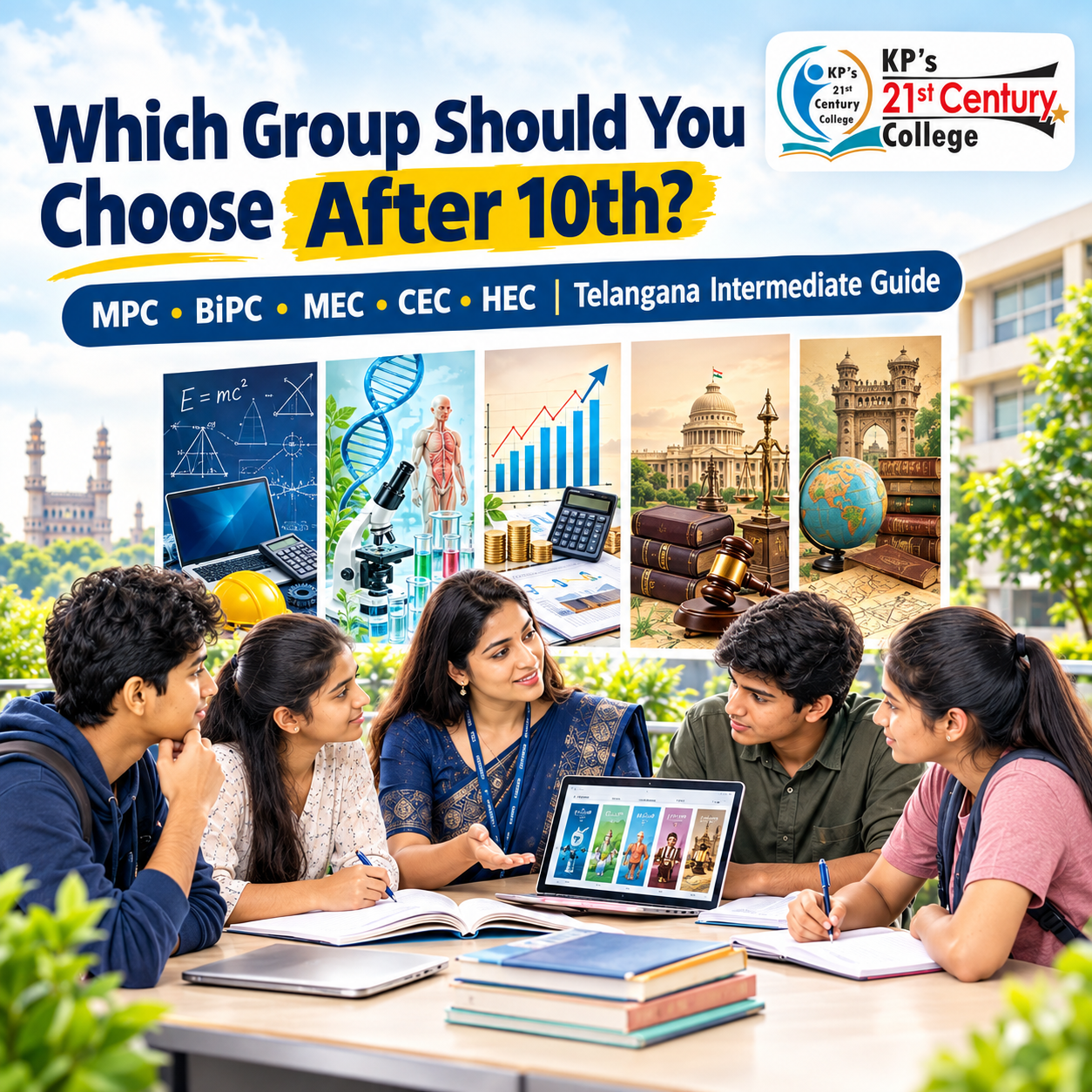
Quick Answer: Which Stream Is Best After 10th?
There is no universally best group after 10th class. The best Intermediate group is the one that matches your subject strengths and career direction. As a broad guide:
- MPC (Maths, Physics, Chemistry) suits students comfortable with Mathematics and numerical problem-solving, aiming at engineering, technology and related fields.
- BiPC (Biology, Physics, Chemistry) suits students drawn to Biology, health sciences, pharmacy, agriculture and life sciences.
- MEC (Maths, Economics, Commerce) suits students interested in business, finance, accounting and economics, with the added advantage of Mathematics.
- CEC (Civics, Economics, Commerce) suits students interested in commerce, law, management and public-service-oriented pathways, with less Mathematics.
- HEC (History, Economics, Civics) suits students who enjoy reading, social sciences, governance, law and humanities-based careers.
No group guarantees a career or an exam result. Preparation, consistency and the degree you take afterwards matter far more than the label on your Intermediate certificate.
First, Some Telangana and Andhra Pradesh Context
Intermediate education in Telangana and Andhra Pradesh follows state-specific Board structures, but students in both states commonly consider groups such as MPC, BiPC, MEC, CEC and HEC after Class 10.
In Telangana, Intermediate education is administered by the Telangana Board of Intermediate Education (TGBIE). In Andhra Pradesh, it is administered by the Board of Intermediate Education, Andhra Pradesh (BIEAP). Subject combinations, examination structures and admission rules can differ between the two states, so students should check the latest rules applicable to their state and admission year.
The important point is the same in both states: choosing an Intermediate group can influence which subject-based entrance examinations and degree pathways remain directly available after Class 12.
That is the real weight of the decision — not prestige, but eligibility, preparation time and keeping the right career options open.
The Five Streams in One Table
| Stream | Core Subjects | Best For | Major Career Paths | Competitive Exam Relevance | Difficulty / Workload | Choose If… |
| MPC | Mathematics, Physics, Chemistry | Students strong in Maths and logical reasoning | Engineering, technology, computer science, architecture, research, defence technical entries | JEE Main & Advanced, TG EAPCET (Engineering), NDA, NATA | High — daily problem practice is non-negotiable | You enjoy solving problems more than memorising |
| BiPC | Botany, Zoology, Physics, Chemistry | Students drawn to Biology and human/plant systems | Medicine, dentistry, pharmacy, nursing, physiotherapy, agriculture, biotechnology, allied health | NEET-UG, TG EAPCET (Agriculture & Pharmacy) | High — large volume of Biology plus Physics numericals | You like understanding living systems and can sustain heavy revision |
| MEC | Mathematics, Economics, Commerce | Students who like numbers but prefer business over Physics | CA, CMA, CS, banking, finance, analytics, management, economics | CA/CMA/CS Foundation, CUET, IPMAT, later banking & SSC exams | Moderate to high — conceptual, with steady Maths | You want a commerce path without losing Mathematics |
| CEC | Civics, Economics, Commerce | Students interested in commerce, law and society, with little Maths | Law, B.Com, management, journalism, public administration, business | CLAT, CUET, CA/CMA/CS Foundation, later civil services | Moderate — more theory, less calculation | You enjoy commerce and social sciences but not Mathematics |
| HEC | History, Economics, Civics | Students who enjoy reading, writing and current affairs | Law, civil services, teaching, journalism, policy, social sciences, public administration | CLAT, CUET, later UPSC / TGPSC / SSC | Moderate — reading and writing intensive rather than numerical | You are genuinely interested in governance, history and society |
Reading the table honestly: notice that “difficulty” is not the same as “value.” MPC and BiPC carry heavier daily workloads because of practice and revision demands, but a student who struggles through MPC will almost always do worse than a student who thrives in CEC. The group that lets you score well and stay motivated for two years is worth far more than the group with the best reputation.
What Each Stream Actually Contains
MPC After 10th
Subjects
MPC covers Mathematics, Physics and Chemistry. In the Intermediate system followed in Telangana and Andhra Pradesh, Mathematics is taught through separate papers, so MPC students have a substantial Mathematics workload from the beginning.
- Mathematics builds algebra, trigonometry, calculus and coordinate geometry — the language used in many engineering entrance examinations.
- Physics applies mathematical concepts to areas such as motion, electricity, optics and modern physics.
- Chemistry combines numerical problem-solving in physical chemistry with conceptual understanding of organic and inorganic chemistry.
What students actually study
MPC is a practice-oriented stream, not a reading-only stream. You learn a concept and then solve problems until the method becomes familiar. Formula memorisation alone is rarely enough because entrance examinations often present familiar concepts in unfamiliar ways.
Difficulty
MPC tends to suit students who genuinely enjoyed Class 10 Mathematics, like solving problems and are comfortable working through difficult questions. It can be challenging for students who performed well in Mathematics mainly by memorising procedures, because Intermediate Mathematics requires stronger conceptual understanding and regular practice.
Daily workload
Realistically, MPC demands consistent daily practice rather than exam-time cramming. Students who postpone problem-solving until the week before examinations can quickly fall behind. When entrance-exam preparation is undertaken alongside board studies, the workload increases further, which is why many students and parents consider integrated programmes that combine Intermediate academics with entrance preparation.
Best suited for
Students interested in engineering, computer science and software, data and analytics, core technology, pure Mathematics or Physics research, architecture, and technical career pathways.
Potential competitive examinations
MPC is the standard subject combination for JEE Main and JEE Advanced engineering pathways. Students in Telangana can also pursue eligible engineering admissions through TG EAPCET, while students in Andhra Pradesh can use AP EAPCET for relevant state-level admissions, subject to the eligibility and admission rules applicable in the respective year.
Architecture pathways may involve NATA or the architecture paper of JEE, depending on the institution and admission route, and Mathematics is an important requirement for these pathways.
Entrance-examination rules and admission requirements can change. Students should always check the official notification for their admission year before making a final decision.
Career options
B.Tech / B.E. across engineering branches, B.Arch, B.Sc. in Mathematics, Physics, Chemistry, Statistics or Computer Science, integrated M.Sc. programmes, research careers and several technology-related degree pathways. MPC students can also move into commerce, management and professional courses later, including CA and MBA, subject to the respective eligibility requirements.
📌 Read more: MPC stream after 10th
BiPC After 10th
Subjects
BiPC covers Botany, Zoology, Physics and Chemistry. Biology is generally divided into Botany and Zoology in the Intermediate structure, meaning BiPC students study four major subjects along with their practical and examination requirements. Exact paper structures and subject arrangements can vary between the Telangana and Andhra Pradesh boards.
Learning in BiPC requires a combination of three skills: understanding processes, representing them accurately through diagrams and classifications, and retaining a large amount of terminology and factual information.
Physics and Chemistry still involve numerical problem-solving, which can surprise students who choose BiPC expecting to avoid Mathematics completely.
Difficulty and workload
The challenge in BiPC is largely volume, understanding and retention. Biology rewards students who revise regularly rather than trying to memorise everything immediately before examinations. Chemistry requires conceptual clarity, particularly in organic chemistry, while Physics continues to require numerical practice.
A student who enjoys Biology but strongly dislikes Physics should think carefully before choosing BiPC. Physics remains an important part of the stream and of medical entrance preparation.
Best suited for
Students interested in medicine, dentistry, AYUSH systems, pharmacy, nursing, physiotherapy, veterinary science, agriculture and horticulture, biotechnology, microbiology, food technology, forensic science and allied health professions.
Competitive examinations
NEET-UG is the major national entrance examination for undergraduate medical and several other health-related courses, including MBBS and BDS, with eligibility based on the prescribed subjects and requirements.
Students in Telangana can also use TG EAPCET for eligible Agriculture and Pharmacy-related admissions. Students in Andhra Pradesh can pursue relevant Agriculture and Pharmacy pathways through AP EAPCET, depending on the courses offered and the eligibility rules notified for that admission year.
Students interested in biotechnology and technology-related degree programmes should check the specific eligibility requirements of the university and course before choosing BiPC. Some programmes may require Mathematics or an additional bridge-course requirement.
Choosing BiPC does not mean becoming a doctor.
Medical seats are limited and competition for NEET is high. A student choosing BiPC should therefore be genuinely comfortable with the wider range of Biology-based careers rather than selecting the stream solely because of an MBBS goal.
Career options
MBBS, BDS, BAMS, BHMS and other eligible AYUSH pathways, B.Pharmacy and Pharm.D, B.Sc. Nursing, BPT, B.V.Sc., B.Sc. Agriculture, biotechnology, clinical research, biomedical sciences, food science, microbiology and various research careers.
📌 Read more: BiPC stream after 10th
MEC After 10th
Subjects
MEC combines Mathematics, Economics and Commerce, making it a strong option for students who want a commerce-oriented Intermediate pathway while keeping Mathematics in their subject combination.
Commerce introduces students to accounting principles, business organisation and financial records. Economics develops an understanding of markets, production, consumption, national income and economic development. Mathematics keeps several quantitative and analytical pathways open.
Difficulty and workload
MEC sits between the science groups and the more theory-oriented groups. Accountancy requires accuracy and regular practice — one incorrect entry can affect an entire accounting problem. Economics requires conceptual understanding and written answers, while Mathematics requires the same consistent practice it demands in other streams.
Students sometimes underestimate MEC because it is not labelled as a science stream. In practice, students preparing for professional examinations such as CA Foundation alongside Intermediate can have a substantial workload.
Best suited for
Students interested in chartered accountancy, cost accountancy, company secretaryship, banking, finance, business analytics, economics, entrepreneurship and management.
Competitive examinations and professional pathways
The CA Foundation examination conducted by ICAI is open to eligible students from different Class 12 streams, including commerce, science and arts. MEC can provide a useful academic foundation because students are already familiar with subjects such as accounting and economics.
Similar professional pathways are available through CMA and CS, subject to the current eligibility and registration requirements of the respective professional bodies.
MEC students can also appear for CUET-UG for eligible university admissions and may consider IPMAT and other management entrance examinations. Mathematics can be particularly useful for entrance tests that include quantitative aptitude.
What MEC generally does not provide is the subject combination normally required for engineering admission through TG EAPCET or AP EAPCET, where Mathematics is combined with Physics and Chemistry for the relevant engineering pathway.
Career options
B.Com, BBA, B.A. Economics, B.Sc. Statistics or Data Science, CA, CMA, CS, banking and insurance, financial analysis, taxation, audit, business consulting, business analytics, management and entrepreneurship. MBA remains an option after completing an eligible undergraduate degree.
📌 Read more: MEC stream and career options
CEC After 10th
Subjects
CEC covers Civics, Economics and Commerce. It is closely related to MEC, with Civics replacing Mathematics.
Civics develops an understanding of the Constitution, government institutions, rights, political processes and public administration. Economics introduces students to economic concepts and development, while Commerce provides a foundation in accounting and business.
Difficulty and workload
CEC is comparatively less calculation-heavy and more comprehension-oriented. Accountancy still requires precision and regular practice, but there is no separate Mathematics paper.
It can suit students who express themselves well in writing, follow current affairs and enjoy understanding how governments, businesses and society function.
This does not mean CEC is an easy stream. Students who choose it only to avoid Mathematics, without any genuine interest in commerce, society or public affairs, may struggle to stay motivated.
Best suited for
Students interested in law, business, management, journalism, public administration, human resources, social work and government-service-oriented careers.
Career options and pathways
CLAT, conducted by the Consortium of National Law Universities, accepts students from different Intermediate streams, subject to the qualifying criteria specified in the current notification. CEC does not provide an exclusive eligibility advantage for law, but subjects such as Civics and Economics can provide useful background knowledge for areas covered in law entrance preparation.
Degree options include B.Com, BBA, BA in Political Science or Economics, Journalism and Mass Communication, five-year integrated LLB programmes, and various management, hospitality and event-management courses.
CEC students can also pursue professional routes such as CA, CMA and CS, subject to the applicable eligibility requirements.
Career options
Law, management, commerce, banking, journalism, public administration, human resources, social work, entrepreneurship, media, hospitality and government-service-oriented careers.
📌 Read more: CEC stream after 10th
HEC After 10th
Subjects
HEC covers History, Economics and Civics and is the humanities-oriented Intermediate group.
- History develops chronological understanding, cause-and-effect reasoning and the ability to construct arguments.
- Civics introduces constitutional principles, governance, political institutions and public administration.
- Economics adds an understanding of resources, markets, development and public policy.
Difficulty and workload
HEC rewards reading, writing, analysis and regular revision rather than numerical problem-solving.
The workload may be lighter in terms of mechanical calculations but heavier in terms of comprehension, reading and retention. Students who enjoy reading, writing and following current affairs can find HEC a strong fit.
Students should not choose HEC simply because they believe it is an “easy” stream. Good performance still requires regular reading, structured answers and conceptual understanding.
Best suited for
Students interested in civil services, law, public policy, teaching, journalism and media, history and archaeology, sociology, psychology, international relations and social work.
Civil services connection
HEC overlaps substantially with areas of general studies relevant to UPSC, TGPSC and APPSC examinations. This can make subjects such as Polity, History and Economy familiar to students who later decide to prepare for civil services or state public-service examinations.
That overlap is useful, but it should not be confused with a guaranteed competitive-exam advantage.
An important caution
Competitive-exam success depends on preparation, consistency, analytical ability and performance — not simply on the Intermediate group chosen.
Engineers, doctors, commerce graduates and humanities graduates all enter civil services. HEC can provide an early academic exposure to several relevant subjects, but students should still protect their Intermediate academics and build broader skills such as reading comprehension, writing and general awareness.
Career options
BA programmes in History, Political Science, Economics, Sociology, Psychology and related disciplines; law, journalism and mass communication, public policy, teaching, social sciences, social work, civil services preparation, research, media and other humanities-oriented careers.
📌 Read more: HEC stream and career pathways
Which Entrance Exams Does Each Stream Set You Up For?
| Stream | Major Entrance / Competitive Pathways | Typical Career Direction |
| MPC | JEE Main, JEE Advanced, TG EAPCET (Engineering), NATA, NDA, state and institute-level engineering tests | Engineering, technology, architecture, research, defence technical |
| BiPC | NEET-UG, TG EAPCET (Agriculture & Pharmacy), nursing and paramedical entrance tests | Medicine, dentistry, pharmacy, agriculture, allied health, life sciences |
| MEC | CA / CMA / CS Foundation, CUET-UG, IPMAT, later banking, SSC and TGPSC exams | Finance, accounting, analytics, management, economics |
| CEC | CLAT, CUET-UG, CA / CMA / CS Foundation, later UPSC, TGPSC, SSC, banking | Law, commerce, management, public service |
| HEC | CLAT, CUET-UG, later UPSC, TGPSC, SSC, banking, teaching eligibility tests | Civil services, law, policy, teaching, media, social sciences |
The distinction that matters most
Families frequently confuse two very different things:
Formal Eligibility vs Useful Foundation
- A formal eligibility requirement is a rule set by an examination authority, university or professional body. For example, NEET-UG requires candidates to meet the prescribed 10+2 subject requirements, including Physics, Chemistry and Biology/Biotechnology. Similarly, engineering admission through TG EAPCET in Telangana and AP EAPCET in Andhra Pradesh requires the prescribed Mathematics, Physics and Chemistry combination for the relevant engineering pathway. If you do not meet the required subjects or other eligibility conditions, you may not be eligible for that particular route.
- A useful foundation is an advantage, not a formal requirement. HEC can provide early exposure to subjects relevant to UPSC and state public-service examinations. MEC can give students a head start in accounting and economics for professional courses such as CA. CEC can provide useful background for law and public-policy pathways. But these streams are not compulsory for those careers.
Graduate-level examinations — UPSC Civil Services, TGPSC Group I and Group II, APPSC Group I and Group II, SSC, IBPS and other banking exams — are open to graduates of any discipline. Your Intermediate group does not determine eligibility for them. It only determines how early you encounter the relevant subject matter.
Check the Official Eligibility Rules
Exam patterns, subject mappings and eligibility percentages do change. Before finalising anything, check the current notification on the official source: tgbie.cgg.gov.in for Telangana Intermediate, bie.ap.gov.in for Andhra Pradesh Intermediate, eapcet.tsche.ac.in for TG EAPCET, cets.apsche.ap.gov.in for AP EAPCET, nta.ac.in for JEE, NEET and CUET, and icai.org for CA.
Career and Earning Outcomes Per Stream
This is where most articles start making promises. We will not.
Earnings in India depend on your profession, qualification level, institution, city, skills and years of experience — not on your Intermediate group. A B.Tech graduate from a well-placed institute and a B.Tech graduate from a college with weak placements can have very different starting outcomes with the same degree. A chartered accountant, a doctor, a lawyer and a civil servant all reach senior earnings, but through very different timelines.
A few honest patterns worth knowing:
| Stream | Popular Degrees | What Actually Drives Outcomes |
| MPC | B.Tech, B.Arch, B.Sc | Institute quality, coding and domain skills, internships, ability to keep learning as technology shifts |
| BiPC | MBBS, BDS, B.Pharmacy, B.Sc Agriculture, B.Sc Nursing | Length of qualification (PG matters a lot in medicine), specialisation, clinical experience, licensing |
| MEC | B.Com, BBA, CA, CMA, Economics | Professional certification, articleship quality, analytical and software skills |
| CEC | B.Com, BBA, LLB, BA | Institution reputation for law, internships, communication ability, specialisation |
| HEC | BA, LLB, Public Administration, Journalism | Postgraduate study, competitive exam success, writing and research skill |
Three realities parents should weigh:
- Time to first income differs. Commerce and humanities degrees often lead to employment in three years. Medicine takes considerably longer, especially with postgraduate specialisation. Neither is better — they are different timelines.
- The degree is the beginning, not the end. Skills built during the degree — internships, communication, technical tools, certifications — usually predict outcomes better than the degree title.
- A struggling student in a “high-paying” stream earns nothing extra. Marks, confidence and momentum compound. A student who performs strongly in CEC and enters a good law programme will typically do far better than a student who barely passes MPC.
MPC vs BiPC vs MEC vs CEC vs HEC — Which One Is Right for You?
| If you enjoy… | Consider |
| Maths + Physics + problem-solving | MPC |
| Biology + healthcare + life sciences | BiPC |
| Business + Maths + Economics | MEC |
| Commerce + social sciences + law/business | CEC |
| History + civics + humanities + public service | HEC |
- If you enjoy Maths and Physics: you already have the single most important requirement for MPC — tolerance for repeated problem-solving. Engineering entrance preparation is essentially two years of structured practice, and students who dislike this find it exhausting rather than interesting.
- If you enjoy Biology: BiPC will feel natural, but be honest about Physics. Ask yourself whether you can spend two years on Physics numericals while carrying two Biology papers.
- If you like numbers but not Physics: MEC is often the most underrated choice in Telangana and Andhra Pradesh. It keeps Mathematics, opens the CA/CMA/CS routes, and supports economics and analytics degrees where quantitative ability is valued.
- If commerce interests you but Mathematics does not: CEC removes the Maths pressure while keeping business and social sciences. It is a strong base for law through CLAT.
- If you read widely and follow current affairs: HEC gives you a genuine head start on the general studies foundation used in UPSC and TGPSC preparation — provided you actually study it rather than treating it as the light option.
Still uncertain? Our career guidance after 10th resources walk through each pathway in more detail.
Which Group Is Best for Competitive Exams?
There is no single best group for all competitive exams, because competitive exams sit at different levels — some immediately after Intermediate, some only after a degree.
- Engineering and technical entrances — JEE, TG EAPCET Engineering, NDA technical entries. Strongest alignment: MPC. These have explicit subject requirements that only MPC satisfies.
- Medical and health science entrances — NEET-UG, TG EAPCET Agriculture & Pharmacy. Strongest alignment: BiPC, again because of formal subject requirements.
- Commerce and professional finance — CA, CMA, CS. MEC or CEC both work, and so does any other group, since these Foundation examinations accept students from every stream. MEC students simply start with familiar material.
- Law — CLAT, CUET-based law programmes. CEC and HEC provide useful subject exposure in Civics, Economics and History, which overlaps with legal reasoning and general knowledge sections. But eligibility is based on your 10+2 percentage, not your group, so verify the current notification.
- Civil services and state public service — UPSC, TGPSC, APPSC. HEC and CEC cover Polity, History and Economy early, which is a genuine head start over two to three years. That said, these are graduate-level examinations open to every discipline, and toppers regularly come from engineering and medical backgrounds.
- Banking, SSC and other graduate-level exams — the Intermediate group is largely irrelevant here. What matters is your degree, your aptitude and reasoning preparation, and your consistency in the final two years before the exam.
The takeaway: your group decides which exams you are eligible for immediately after Intermediate. For everything at graduate level, preparation decides the outcome.
The Three Mistakes Families Make When Choosing a Stream
Mistake 1: Choosing based on friends
This is the most common and the most damaging. Your friend may find Physics intuitive while you find it draining. Two years later, one of you is scoring well and the other has lost confidence — and the friendship rarely survives the college timetable anyway, since students are separated by group and section from the first week.
What to do instead:
discuss options with friends, but decide based on your own Class 10 experience — which subjects you understood without extra effort, and which ones you avoided.
Mistake 2: Choosing based only on salary
Salary figures circulating on social media are usually top-percentile outcomes presented as typical. They ignore the years of study, the competition, and the number of students who did not reach that outcome.
Aptitude compounds over time. A student who enjoys their subjects studies more, scores better, gets into a better institution, and builds skills faster. A student who chose a group purely for its reputation typically does the opposite.
What to do instead:
look at the work, not the package. Would you enjoy spending your days doing what this profession actually involves?
Mistake 3: Treating one stream as “superior”
In Telangana and Andhra Pradesh, MPC and BiPC carry more social prestige — partly because engineering and medicine have long been the default aspirations. But prestige is not the same as suitability.
MPC, BiPC, MEC, CEC and HEC simply serve different interests. A talented commerce student is not “less than” a struggling science student. The five groups lead to five different sets of doors, and all of them are worth walking through if they suit you.
Practical advice for parents
- Ask which subject your child voluntarily studies first when they sit down. That is genuine interest.
- Look at Class 10 performance subject-by-subject, not just the total percentage.
- Let your child articulate their reasoning. If they cannot explain why they want a group, they may be repeating what they heard.
- Avoid comparisons with relatives’ children. Different students, different aptitudes.
- If genuinely unsure, seek structured counselling rather than settling the debate at home by seniority.
A 6-Question Self-Check
Answer honestly. Write your answers down before discussing them with anyone.
- Which subjects did you genuinely enjoy in Class 10 — not which ones you scored highest in, but which ones you did not mind studying?
- Do you enjoy solving numerical problems, including the frustration of getting them wrong before getting them right?
- Do you enjoy Biology and understanding how living systems work?
- Are you interested in business, money, accounting or economics — do you follow how companies, prices or markets work?
- Do you enjoy history, politics, society and reading, including newspapers and long-form articles?
- What career direction interests you most right now, even if you are not certain?
How to interpret your answers
| Your answers lean toward… | Consider |
| Maths and physical sciences | MPC |
| Biology and health | BiPC |
| Business, finance, economics with Maths | MEC |
| Commerce, law, management without Maths | CEC |
| Humanities, public service, social sciences | HEC |
Important: This is a starting point for a conversation, not a psychological or career aptitude test. Six questions cannot capture a student’s full profile. Use it to narrow five options down to two, then discuss those two properly with a teacher or counsellor.
How Parents Can Help Their Child Choose the Right Group
- Observe aptitude, not just marks. Marks reflect effort and coaching as much as ability. Aptitude shows up in what your child does without being asked — the questions they raise, the videos they watch, the problems they enjoy.
- Ask genuinely open questions. “What did you like about that subject?” gets a more useful answer than “Don’t you think MPC is better?”
- Discuss careers without deciding them. Describe what different professionals actually do day-to-day. Many students choose blindly simply because nobody has ever explained what an economist, a company secretary or a pharmacist does.
- Consider workload and learning style honestly. A student who cannot sustain daily problem practice will struggle in MPC regardless of ability. A student who dislikes reading will struggle in HEC.
- Resist social pressure. The stream your neighbour’s child chose is information about that child, not about yours.
- Encourage counselling when uncertain. A structured conversation with someone who works with students across all five groups usually clarifies things faster than months of family debate.
Final Verdict
- Choose MPC if you are comfortable with Mathematics, enjoy problem-solving over memorisation, and are interested in engineering, technology, architecture or the physical sciences.
- Choose BiPC if you are genuinely drawn to Biology, can sustain high-volume revision alongside Physics numericals, and are open to the full range of health, pharmacy, agriculture and life science careers — not only MBBS.
- Choose MEC if you want a commerce path but do not want to give up Mathematics, and you are interested in chartered accountancy, finance, economics, analytics or business.
- Choose CEC if commerce and social sciences interest you more than Mathematics, and you are considering law, management, media or public-service-oriented careers.
- Choose HEC if you read widely, write well, follow current affairs, and are drawn to civil services, law, policy, teaching or the social sciences.
The best stream is not the one with the biggest reputation. It is the one that matches your strengths, interests and future direction.
Two years is a long time to spend on subjects that do not suit you — and a short time to build a foundation in subjects that do.
Confused Between MPC, BiPC, MEC, CEC and HEC?
At KP’s 21st Century College, our counsellors work with Class 10 students and parents across Telangana every admission season, and we have seen how much clarity a single structured conversation can bring.
Free Stream-Selection Counselling — sit down with a counsellor and work through:
- Subject combinations available in each Intermediate group
- Realistic career pathways after each stream
- Which competitive exams open up, and when preparation should begin
- Your child’s academic strengths and learning style
- The Intermediate stream that genuinely fits — even if it is not the one you walked in expecting
No obligation, no pressure to enrol. If the right answer for your child is a different college or a different group, we will say so.
📞 Speak to a counsellor: +91 91334 37733 / +91 91335 37733
🕘 Counselling hours: Monday to Saturday, 9:00 AM – 6:00 PM
📍 Campus: Nagarguda–Shamshabad Road, Rallaguda, Hyderabad, Telangana
Frequently Asked Questions
Which group is best after 10th class in Telangana?
There is no single best group. MPC suits engineering-oriented students, BiPC suits medical and life science interests, MEC suits finance and commerce with Mathematics, CEC suits law and business without Mathematics, and HEC suits humanities and civil services interests. The best group is the one matching your subject strengths and career direction.
Which is better, MPC or BiPC?
Neither is better overall — they lead to different fields. MPC is the route to engineering, technology and architecture through JEE and TG EAPCET Engineering. BiPC is the route to medicine, pharmacy, agriculture and allied health through NEET-UG and TG EAPCET Agriculture & Pharmacy. Choose based on whether Mathematics or Biology suits you more.
Is MPC harder than BiPC?
They are difficult in different ways. MPC demands sustained numerical problem-solving and abstract reasoning across Mathematics and Physics. BiPC demands retention of a very large volume of Biology content while still handling Physics numericals. Students who like practice usually find MPC easier; students who like understanding systems often prefer BiPC.
Which is better, MPC or MEC?
MPC keeps engineering and technology pathways open through JEE and TG EAPCET. MEC keeps Mathematics while opening commerce and finance routes such as CA, CMA, CS and economics degrees. If you enjoy Physics and Chemistry, choose MPC. If you enjoy Mathematics but prefer business over laboratory sciences, MEC is the stronger fit.
Can I become an engineer after taking MEC?
Generally no through the standard route. Engineering admission via TG EAPCET requires Intermediate with Mathematics, Physics and Chemistry, which MEC does not include. Some polytechnic and lateral-entry pathways exist, but they are indirect. If engineering is your goal, MPC is the appropriate choice at Intermediate level.
Can BiPC students pursue careers other than MBBS?
Absolutely, and most do. BiPC opens dentistry, pharmacy, Pharm.D, nursing, physiotherapy, veterinary science, agriculture and horticulture, biotechnology, microbiology, food technology, forensic science, clinical research and hospital administration. Given how competitive MBBS admission is, students should enter BiPC comfortable with this wider range, not only medicine.
Is CEC a good group after 10th?
Yes, for the right student. CEC combines Civics, Economics and Commerce, making it a strong foundation for law through CLAT, for B.Com and BBA degrees, and for management and public-service-oriented careers. It suits students who enjoy commerce and social sciences but do not want a separate Mathematics paper.
What can I do after taking HEC?
HEC leads to BA programmes in History, Political Science, Economics and Public Administration, five-year integrated LLB courses through CLAT or CUET, journalism and media degrees, and teaching pathways. It also gives early exposure to Polity, History and Economy, which overlaps with UPSC and TGPSC general studies preparation.
Which group is best for competitive exams?
It depends on the exam. MPC aligns with engineering entrances, BiPC with medical entrances, MEC and CEC with commerce and professional finance examinations, and CEC or HEC with law and civil services foundations. For graduate-level exams such as UPSC, TGPSC, SSC and banking, your Intermediate group does not determine eligibility.
Which group is best for government jobs?
No group guarantees a government job. Most government examinations — UPSC, TGPSC, SSC, banking — require a degree, and graduates from every stream are eligible. HEC and CEC give earlier exposure to the general studies content these exams test, which is a preparation advantage rather than an eligibility one.
Can MEC students prepare for competitive exams?
Yes. MEC students are eligible for CA, CMA and CS Foundation examinations, CUET-UG, IPMAT and, after graduation, banking, SSC, TGPSC and UPSC examinations. The Mathematics and Economics background is particularly useful for the quantitative and economy sections in banking and civil services papers.
Can CEC students pursue law?
Yes. CLAT and most university law programmes accept students from any Intermediate group, subject to the minimum percentage specified in the official notification. CEC’s Civics and Economics subjects overlap usefully with legal reasoning and general awareness sections, though they are an advantage rather than a formal requirement.
Which stream is best for business?
MEC and CEC both suit business-oriented students. MEC adds Mathematics, which helps in finance, analytics and quantitative management. CEC leans towards commerce and social sciences. For entrepreneurship specifically, no group is mandatory — business skills develop through the degree, internships and practical experience.
Which stream is best for civil services?
HEC gives the earliest exposure to Polity, History and Economy, which form the core of UPSC and TGPSC general studies. CEC is a close second. However, civil services examinations are open to graduates of every discipline, and candidates from engineering, medical and commerce backgrounds qualify every year. Preparation matters more than stream.
How should parents help students choose a stream?
Observe which subjects your child studies willingly, look at subject-wise Class 10 performance rather than the overall percentage, explain what different professions actually involve day-to-day, and let your child explain their own reasoning. If uncertainty persists, structured career counselling usually resolves it faster than family debate.
Can I change my career after choosing a stream?
Yes, though some doors close. Commerce, management, law, civil services and most graduate-level examinations remain open to students from every stream. However, engineering and medicine have strict subject requirements at 10+2, so switching into them later is difficult. This is why the Intermediate decision deserves careful thought.
What should I choose if I am confused between MPC and BiPC?
Ask which subject you would rather study on a difficult day — Mathematics or Biology. Both groups include Physics and Chemistry, so the real choice is between sustained numerical problem-solving and high-volume conceptual retention. If you still cannot decide, speak to a counsellor before admission rather than after.