Introduction
Every year around results week, a version of this conversation happens in thousands of homes across Hyderabad. A Class 10 student, fresh from board exams, announces: “I want to become an IAS officer. Why should I wait until graduation to start?”
It is a fair question, and it deserves a better answer than “yes, start early” or “no, study your Intermediate first.”
This article is written for Class 10 students entering Intermediate in 2027 and for the parents who have to sign the admission form. It answers, honestly, whether UPSC preparation after 10th is a genuine advantage — and, more usefully, what “starting” should actually look like at age 15 or 16.
The distinction that runs through everything below is this: early foundation and full-scale UPSC preparation are two completely different things. Confusing them is the single most common mistake families make at this stage.
The Honest Answer — Is Starting UPSC Afiter 10th Actually Good?
Yes, starting UPSC foundation after 10th can be an advantage — but only when “starting early” means developing the right habits and foundations, not putting a Class 11 student through the same preparation intensity as a graduate aspirant.
A 15-year-old cannot write the Civil Services Examination. The Union Public Service Commission requires a candidate to have attained 21 years of age and to hold a Bachelor’s degree from a recognised university. So the realistic question is not “can I prepare early?” but “what is worth building in the six or seven years before I am eligible?” The answer is reading ability, subject familiarity, general awareness, writing skill and self-knowledge — none of which can be crammed later, and all of which grow slowly.
Starting afiter 10th can make sense ifi:
- The student genuinely wants to explore civil services, not just repeat a phrase heard at home
- The student enjoys reading, or is willing to build the habit
- There is real curiosity about society, government and current affairs
- Intermediate academics can be maintained at a strong level
- The programme is age-appropriate for a 15–16-year-old
- The focus is foundation-building, not exam simulation
- The student keeps other career doors open
Starting afiter 10th may not be appropriate ifi:
- Parents want IAS and the student does not
- The student is genuinely unsure and feels pressured to decide now
- Intermediate marks are already slipping
- The daily workload leaves no room for sleep, sport or family
- The student dislikes reading and theory-heavy learning
- There is a strong, specific alternative goal that needs full attention
If most of the second list describes your situation, waiting is not a failure. It is a reasonable decision.
What Does a 5-Year Head Start Actually Buy You?
“Five extra years of preparation” is the wrong way to think about it. Nobody can usefully prepare for a specific examination for eleven years. What those years can realistically buy is capability.
1. Reading Habit
UPSC is, at its core, a reading examination. A candidate who reads comfortably for three hours has an enormous practical advantage over one who tires after forty minutes — and that stamina is built slowly.
Starting in Class 11 allows a student to move gradually from simple news summaries to full newspaper reading, then to editorials, then to NCERT textbooks and eventually to standard reference books. Reading speed and comprehension improve with years of practice, not weeks of effort.
2. Subject Familiarity
Early exposure to History, Geography, Indian Polity, Economics, Environment and Society means that when a graduate-level aspirant opens a Polity textbook, the Constitution is not a stranger.
Familiarity reduces the feeling of encountering an entire universe of subjects for the first time at 21. It does not replace the deeper study that comes later, but it lowers the intimidation cost considerably.
3. Better General Awareness
Understanding how a Budget works, why a Supreme Court judgment matters, what a bilateral agreement changes, or how an environmental clearance operates — this understanding accumulates.
A word of caution: a Class 11 student should not be memorising daily current-affairs facts five years in advance. The facts will be obsolete. The understanding will not.
4. Writing and Communication
Mains and the Essay paper reward structured thinking expressed in clear, evidence-backed prose. Very few students possess this at 21 and almost none acquire it in a six-month crash course.
Between Class 11 and graduation, a student can progressively build reading comprehension, paragraph structure, argument construction, vocabulary, clarity and the habit of supporting claims with evidence. Writing is a skill, and skills need years of feedback.
5. More Time to Discover Whether UPSC Actually Suits Them
This may be the most valuable return of all.
Early exposure lets a student ask the honest question: “Do I actually enjoy this kind of learning?” Some students discover they love reading about governance and public policy. Others discover, within a year, that they prefer laboratories, code, courtrooms or markets.
Finding this out at 16 is far better than finding it out at 25 after three attempts. A foundation programme that helps a student make an informed choice has done its job even if that choice turns out to be “not UPSC.”
What It Costs — Time, Childhood and Opportunity
Any honest article on early UPSC preparation must discuss the price.
Time
There are only so many hours in a school day. Adding a UPSC foundation stream means competing with Intermediate coursework, entrance preparation, sleep, sport, hobbies, family time and friendships.
A tired 16-year-old does not learn well. If the timetable requires sacrificing sleep, the programme is badly designed, not ambitious.
Academic Opportunity Cost
Intermediate marks still matter. They determine admission to good undergraduate programmes in Engineering, Medicine, Law, Commerce, Management, Technology, Research and Humanities — including the degrees that most civil servants hold.
Since UPSC requires a Bachelor’s degree anyway, the undergraduate pathway is not a detour from civil services. It is a compulsory part of it. A good foundation programme protects Intermediate performance rather than treating it as secondary.
Pressure
There is a meaningful difference between two sentences: “You must become an IAS officer.”
“Let us help you explore and prepare for civil services.”
The first creates a teenager carrying a family’s expectations. The second creates a curious student. Age-appropriate expectations are not soft — they produce better long-term outcomes, because motivation that comes from inside survives setbacks.
Loss ofi Flexibility
A 15-year-old does not need to lock their entire life around one career path. Interests change between 15 and 21, and they should be allowed to.
A well-designed Inter + IAS programme should widen a student’s options, not narrow them. If a programme makes it harder to pivot to Engineering, Law or research later, that is a design flaw.
Who Should Consider Inter + IAS — And Who Shouldn’t?
| Student Profile | Inter + IAS Foundation | Reason |
| Strong interest in civil services | Potentially suitable | A long runway suits a long-term goal |
| Loves reading and current affairs | Potentially suitable | Natural alignment with how UPSC tests |
| Curious but undecided | Possible | Keep it exploratory, with an exit option |
| Strong JEE/NEET-focused goal | Depends | The primary academic pathway must stay protected |
| Dislikes reading | Usually unsuitable | UPSC demands sustained reading for years |
| Easily overwhelmed by schedules | May be unsuitable | A foundation should reduce anxiety, not add to it |
| Parents want IAS but student doesn’t | Poor fit | Borrowed motivation rarely lasts six years |
| Interested in humanities/social sciences | Potentially suitable | Subject alignment makes the load lighter |
A note on the fourth row: a student seriously targeting JEE or NEET already carries a heavy load. Adding a full UPSC foundation stream on top is usually a mistake. A lighter approach — newspaper reading and a general-awareness habit — preserves the option without damaging the primary goal.
What the Intermediate–UPSC Syllabus Overlap Really Looks Like
| Intermediate / Foundation Area | UPSC Area | Potential Long-Term Benefit |
| History | GS Paper I | Chronological and historical understanding |
| Geography | GS Paper I | Physical and human geography concepts |
| Political Science / Civics | GS Paper II | Constitution, governance, institutions |
| Economics | GS Paper III | Core economic concepts and vocabulary |
| Environment | GS Paper III | Ecology, biodiversity, climate awareness |
| Current Affairs | GS I, II, III | Contemporary examples for answers |
| Language & Writing | Essay / Mains | Communication and expression |
| Reading Comprehension | Prelims / Mains | Accurate question interpretation |
| Ethics / Values | GS Paper IV | Early exposure to ethical reasoning |
Now the essential caveat:
Intermediate tests recall and application at board-examination level. The Civil Services Examination eventually demands something considerably harder:
- Advanced, multi-dimensional analysis
- Interdisciplinary thinking across subjects
- Mains answer writing under strict word and time limits
- Essay writing on abstract themes
- An Optional Subject studied at honours depth
- Prelims MCQ elimination technique
- Systematic revision across a vast syllabus
- Test-taking strategy and time management
- Continuous integration of current affairs into static subjects
None of this belongs in Class 11. An early start builds the base of the pyramid. The top of the pyramid is built during and after graduation.
What Should a Student Actually Do in Class 11?
Class 11 Priorities
- Strong Intermediate academics — this is the first priority, not the second
- Reading habit — one newspaper daily, one non-textbook book a month
- Basic NCERT-level foundation knowledge in History, Geography, Polity and Economy
- Current affairs awareness — understanding issues, not memorising dates
- Writing practice — short structured pieces, weekly
- Communication — speaking clearly, discussing, defending a view
- General awareness of government, society and the world
- Time management — a routine that is actually sustainable
What a Class 11 student should NOT be doing
- Memorising thousands of facts that will be outdated by the time they are eligible
- Sitting full-scale UPSC mock tests every week
- Studying 10–12 hours a day
- Sacrificing sleep, sport or family time
- Treating every newspaper article as an examination question
If a Class 11 timetable looks like a graduate aspirant’s timetable, something has gone wrong.
What Should a Student Actually Do in Class 12?
Class 12 raises the academic stakes, so the UPSC-oriented component should deepen rather than expand.
The focus shifts to strengthening fundamentals across core subjects, improving structured writing, attempting short essays, reading current affairs analytically rather than passively, building revision habits that will serve for a decade, and developing genuine analytical thinking — the ability to see an issue from economic, social, environmental and governance angles at once.
Preparation can become gradually more UPSC-oriented as the student matures. But board examinations and entrance examinations come first in Class 12. A good programme adjusts its load accordingly instead of pretending the board year does not exist.
Class 11 → Class 12 → Degree → UPSC
- Class 11 — Explore + Build Habits. Reading, curiosity, basic subject exposure, strong Intermediate performance.
- Class 12 — Strengthen + Apply. Better writing, analytical reading, revision discipline, board and entrance focus.
- Undergraduate Years — Deepen + Specialise. Degree subject mastery, deeper GS reading, Optional Subject exploration, serious answer writing.
- Graduation Onwards — Full UPSC Preparation. Complete GS coverage, Prelims practice, Mains answer writing, Essay, Ethics, Optional, test series, revision cycles.
For a student entering Intermediate in 2027: Class 12 ends in 2029, a three-year degree ends around 2032, and a first attempt typically falls around 2032–2033, since a candidate must have attained 21 years of age as on 1 August of the examination year. That is a long road. It is worth walking at a sustainable pace.
This is an example pathway, not a mandatory formula. Plenty of successful candidates never touched UPSC content before graduation.
Inter + IAS vs Regular Intermediate + UPSC Later
| Factor | Inter + IAS Foundation | Regular Intermediate + Later UPSC |
| Early exposure | Earlier | Later |
| Reading habits | Can begin early | Can begin later |
| Subject familiarity | Earlier | Later |
| Time flexibility | Potentially lower | Usually higher |
| UPSC familiarity | Earlier | Later |
| Career exploration | Depends on the programme | Potentially broader |
| Intermediate focus | Must be actively protected | Usually straightforward |
| Factor | Inter + IAS Foundation | Regular Intermediate + Later UPSC |
| Best suited for | Highly motivated, reading-inclined students | Students who want flexibility |
There is no universal winner here. Both routes have produced civil servants, and both have produced students who changed direction happily. The right choice depends on the individual student, not on which option sounds more ambitious.
What a Good Inter + IAS Program Should Actually Provide
If you are evaluating an Inter + IAS program in Hyderabad, these are the ten things worth checking before you pay any fee.
- Strong Intermediate academics. Board results should be the college’s first commitment, not a
- Age-appropriate UPSC foundation. Content pitched at 15–16-year-olds, not repurposed graduate material.
- Reading A structured path from newspapers to editorials to books, with guidance on what to read.
- Current affairs Issue-based discussion rather than fact lists.
- Writing Regular short writing with actual feedback from a teacher who reads it.
- Someone who knows the individual student and can say “ease off” or “push harder”.
- Regular but sustainable Frequent low-stakes checks, not weekly high-pressure mocks.
- Career The programme should leave Engineering, Medicine, Law, Commerce and research pathways fully open.
- Qualified Verify who actually teaches the foundation classes, and attend a demo session.
- Clear syllabus and progression. You should be able to see, in writing, what is covered in each Ask for the UPSC foundation syllabus before enrolling.
“IAS foundation” should never mean simply bolting extra coaching hours onto an already demanding Intermediate schedule. If the only difference between the regular batch and the integrated batch is two extra hours a day, that is additional load, not integration.
What Does an Inter + IAS Student Actually Study?
Rather than a fixed timetable, here is how a balanced week should be weighted:
| Component | Relative Weight | Purpose |
| Intermediate core subjects | Largest share | Board performance and degree admission |
| Foundation subjects (History, Polity, Geography, Economy, Environment) | Moderate | Conceptual base for GS |
| Current affairs discussion | Small, regular | Understanding issues in context |
| Reading time | Daily, protected | Building stamina and comprehension |
| Writing practice | Weekly | Structure, clarity, argument |
| Revision | Weekly | Retention over years |
| Assessment | Periodic, low-pressure | Feedback, not ranking anxiety |
| Mentorship | Periodic | Course correction and morale |
| Rest, sport, family | Non-negotiable | Sustainability |
The last row is not filler. A six-year preparation horizon only works if the student is still willing to study in year four.
How to Evaluate a Programme’s Results
Rather than relying on claims, prospective parents should examine the evidence directly:
- Academic results: Intermediate board performance of previous batches, in full, not selected toppers
- Student outcomes: where students went after Class 12 — degrees, institutions, career paths
- Testimonials: verified, named, and ideally spoken to in person
- Programme structure: the written syllabus and weekly schedule
- Faculty: names, qualifications and who actually teaches the foundation classes
- Long-term progression: what support exists after Class 12
You can review published student results and then ask the counsellor for anything not covered there. Any institution confident in its work will answer specific questions specifically.
Is IAS Foundation Afiter 10th the Same as UPSC Coaching?
No. These are fundamentally different products, and conflating them is how families end up disappointed.
IAS Foundation (afiter 10th)
Focuses on awareness, fundamentals, reading, writing, basic subject exposure, current-affairs understanding and long-term study habits. Success is measured by capability built, not marks scored.
Full UPSC Coaching (afiter graduation)
Involves detailed General Studies coverage, Prelims strategy, Mains answer writing, Essay, an Optional Subject, test series, advanced current affairs and intensive revision. Success is measured against a specific examination in a specific year.
A foundation course prepares a student to prepare. It does not replace the preparation itself. Any programme that markets a Class 11 course as “UPSC coaching” is describing something either mislabelled or inappropriate for the age group.
Does Starting UPSC Afiter 10th Guarantee an Advantage?
No. It creates an opportunity, not an outcome.
Whether that opportunity becomes an advantage depends on consistency over years, genuine aptitude and interest, quality of preparation, self-study discipline, writing ability, revision habits, examination strategy and long-term commitment. A student who starts at
21 with strong reading habits and clear motivation can comfortably outperform one who started at 15 and drifted.
No institution can honestly claim that an early start increases selection probability. The Civil Services Examination is among the most competitive in the country, and outcomes depend on far too many factors for any such guarantee.
Frequently Asked Questions
1. Is it good to start UPSC preparation afiter 10th?
It can be, for the right student. Starting after 10th works when it means building reading, writing, awareness and analytical habits gradually alongside strong Intermediate academics. It does not work when it means full-intensity UPSC coaching at 15, which usually harms both board results and motivation.
2. Can I start IAS preparation in Class 11?
Yes, in foundation form. Class 11 is a reasonable time to begin reading newspapers, covering NCERT-level History, Polity, Geography and Economy, and practising structured writing. You cannot begin actual examination preparation, since you must be a graduate and at least 21 to appear.
3. What is the best age to start UPSC preparation?
There is no single best age. Serious, examination-focused preparation usually begins during or after graduation. Habit-building — reading, writing, general awareness — can begin as early as Class 11. What matters far more than starting age is consistency, comprehension and clarity of purpose.
4. Can I prepare fior UPSC while studying Intermediate?
Yes, in a limited and structured way. Intermediate academics must remain the priority, since your board marks decide your degree options and a degree is compulsory for UPSC. Foundation-level reading and awareness fit alongside Intermediate. Full UPSC preparation does not.
5. Is Inter with IAS coaching worth it?
It is worth it for students who genuinely enjoy reading and are curious about society and governance, provided the programme protects Intermediate performance and career flexibility. For students who are unsure, pressured, or already carrying a heavy JEE or NEET load, it is often not worth the strain.
6. What should I study fior UPSC afiter 10th?
Focus on NCERT-level History, Geography, Indian Polity, Economics and Environment, daily newspaper reading, and weekly writing practice. Avoid memorising current-affairs facts years in advance and avoid advanced reference books. Build comprehension and expression first; content depth comes later.
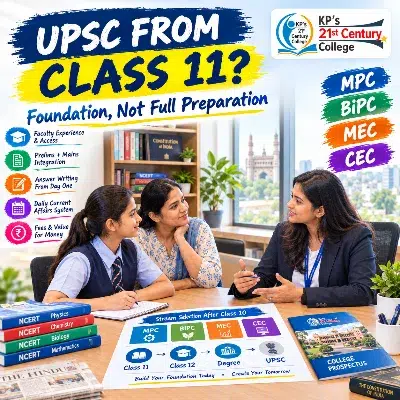
7. Which stream is best fior IAS afiter 10th?
No stream is required or preferred. MPC, BiPC, MEC and CEC students have all cleared the Civil Services Examination. Choose the stream that matches your aptitude and keeps your degree options open, since UPSC only requires a Bachelor’s degree from a recognised university.
8. Is Humanities better fior UPSC?
Humanities subjects overlap more directly with General Studies, which can make early reading feel easier. But Humanities is not compulsory for IAS, and engineering, medical and commerce graduates clear the examination every year. Stream choice should follow interest and career flexibility, not assumed examination advantage.
9. Can MPC students become IAS ofifiicers?
Yes. MPC students regularly become civil servants after completing engineering or science degrees. The Civil Services Examination requires only a Bachelor’s degree, with no restriction on discipline. MPC students may need slightly more deliberate effort on reading and writing skills, which an early start can help with.
10. Can BiPC students become IAS ofifiicers?
Yes. Many doctors and life-science graduates clear the Civil Services Examination. BiPC is a demanding stream, especially alongside NEET preparation, so any UPSC foundation component should stay light — reading and awareness rather than a second full syllabus.
11. Can MEC students prepare fior UPSC?
Yes, and the overlap is helpful. Economics and Commerce subjects connect directly to General Studies Paper III, and Civics content supports Paper II. MEC students often find the transition to economic and governance topics comfortable, though writing and analytical skills still need separate practice.
12. Can CEC students prepare fior IAS?
Yes. CEC includes Civics and Economics, which map closely onto Polity, governance and economy topics in the UPSC syllabus. The subject familiarity is genuinely useful, but it does not replace the deeper, analytical study required at graduate level.
13. Does starting UPSC early guarantee selection?
No. Nothing guarantees selection. Starting early can build stronger reading, writing and analytical foundations, but outcomes depend on sustained effort, aptitude, preparation quality, revision and examination strategy over several years. Be cautious of any institution that suggests otherwise.
14. How many hours should a Class 11 student study fior UPSC?
Far fewer than most people expect. Roughly 45–60 minutes a day of newspaper reading and foundation study, plus some weekly writing, is appropriate alongside a full Intermediate schedule. Anything approaching a graduate aspirant’s workload is counterproductive at this age.
15. Should Class 11 students read newspapers?
Yes — this is arguably the single most valuable habit at this stage. Start with 20–30 minutes covering national, economic and international news, and add editorials gradually. The aim is understanding how issues work, not collecting facts for an examination years away.
16. Is IAS coaching necessary afiter 10th?
No. It is optional. Many successful candidates began after graduation. A structured foundation programme can help a motivated student build habits with guidance, but self-directed reading, good school academics and family support can achieve much of the same outcome.
17. What is an IAS fioundation course?
An IAS foundation course is an age-appropriate programme that builds general awareness, basic subject knowledge, reading ability, writing skill and study habits relevant to civil services. It is preparatory groundwork for school students, distinct from the examination-focused coaching taken by graduate aspirants.
18. What is the dififierence between IAS fioundation and UPSC coaching?
Foundation builds capability — reading, writing, awareness and fundamentals — over years, with no immediate examination. UPSC coaching targets a specific examination cycle with full General Studies coverage, Prelims practice, Mains answer writing, Essay, Optional Subject and test series. Foundation prepares you to prepare.
19. Can I prepare fior JEE/NEET and UPSC together?
Generally, no — not at full intensity. JEE and NEET demand enormous focused practice, and adding a serious UPSC stream usually damages both. A light habit of newspaper reading and general awareness is sustainable and keeps the option open without compromising your primary goal.
20. How should parents decide whether their child should join Inter + IAS?
Start with the student’s own interest, not the family’s ambition. Check whether the programme protects Intermediate academics, whether the workload allows sleep and rest, whether career options stay open, and whether faculty and syllabus are transparent. A counselling session with honest questions usually clarifies it quickly.
Final Answer — Should You Start UPSC Afiter 10th?
Consider starting early ifi:
- You genuinely enjoy reading about history, society, government and economics
- You are curious about how the country is governed
- You want a long-term foundation rather than a shortcut
- You can maintain strong Intermediate performance
- Your parents support the exploration rather than demanding the outcome
Consider waiting ifi:
- You are unsure whether civil services is what you want
- You have another strong, specific career goal
- You dislike reading and theory-heavy subjects
- Your academic workload is already at its limit
- You simply need more time to explore who you are
Not Sure Whether Inter + IAS Is Right fior You?
Book a Counselling Session
A counselling conversation is not an admission formality. It is a chance for the student and parents to ask specific questions and get specific answers about:
- Whether an Inter + IAS pathway genuinely suits this particular student
- What the programme involves week to week
- The realistic academic workload alongside Intermediate
- How the UPSC foundation component is structured across two years
- Subject and stream pathways, and what each keeps open
- Long-term career options beyond civil services
- Whether starting after Class 10 makes sense at all in your case
You should leave a counselling session with a clearer decision — including, quite possibly, the decision not to enrol. That is a legitimate outcome, and a good counsellor will tell you so.
Speak to a counsellor at KP 21st Century College / KP IAS Academy, Hyderabad, or read more about the integrated Intermediate and IAS coaching pathway first.
A Note on Ofifiicial UPSC Requirements
Anything in this article about study approach is educational advice. The following are official requirements, and they are what actually govern eligibility:
- A candidate must have attained 21 years of age and must not have attained 32 years of age as on 1 August of the examination year, with prescribed relaxations for OBC, SC/ST, PwBD and other specified categories.
- A Bachelor’s degree from a recognised university is the minimum educational qualification, and final-year students may appear for the Preliminary Examination provided they produce proof of passing before the Mains
- Attempts are limited to 6 for General and EWS candidates, 9 for OBC and General (PwBD) candidates, and are unlimited for SC/ST candidates up to the upper age An attempt is counted if a candidate appears in even one paper of the Preliminary Examination.
Rules change. A student entering Intermediate in 2027 will become eligible around 2032–2033, and must verify the official notification applicable in their own examination year at upsc.gov.in. Do not rely on this article, or any coaching website, for eligibility decisions.