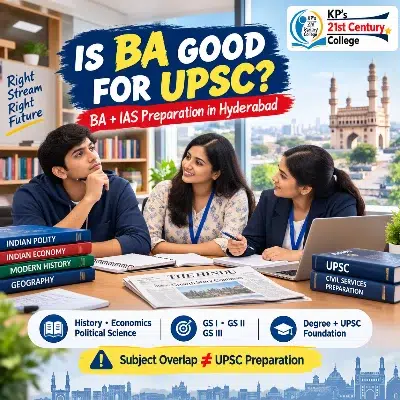
Every year, thousands of students finishing Intermediate in Telangana and Andhra Pradesh ask a version of the same question: “I want to write the Civil Services Examination after graduation — should I take BA because its subjects look like the UPSC syllabus?” It is a fair question, and is BA good for UPSC is one of the most searched phrases by students at exactly this stage. The overlap is real. History, Political Science, Economics and Geography appear in both a BA syllabus and the UPSC General Studies papers.
But the honest answer needs a distinction most articles skip.
What a BA can give you is academic exposure — three years of structured reading in subjects you will meet again during preparation. That is a head start in familiarity, not in selection. Whether that head start is worth anything depends entirely on whether you would enjoy studying those subjects for three years.
This article is for students completing Class 12, students already weighing BA against BCom, BSc and BTech, and parents trying to understand what an integrated Degree + IAS program in Hyderabad actually offers. It covers the subject overlap in detail, the real difference between BA HEPs and BA HEPa, how the optional subject fits in, and what to study year by year.
Is BA Good for UPSC? The Direct Answer
A BA can be a good degree for UPSC preparation, but it is not a requirement and it carries no selection advantage. UPSC accepts any bachelor’s degree from a recognised university. What BA offers is subject overlap: History, Political Science, Economics, Geography, Sociology and Public Administration appear in both BA syllabi and the General Studies papers, so three years of degree study builds familiarity with material you will revisit during preparation. That familiarity helps only if you genuinely enjoy reading and writing about these subjects. A student who takes BA purely as an IAS tactic, without interest in the subjects, gains very little — and is left with a degree they did not want if their career plans change.
BA can be a good choice if
- You enjoy humanities and social sciences as subjects, not just as exam content
- History, Political Science, Economics or Geography already interest you
- You want undergraduate study that runs alongside UPSC preparation rather than against it
- You want three years to build reading stamina and written argument
- You are considering a humanities-linked optional subject later
BA may not be the right choice if
- Your genuine interest is engineering or applied technology
- You want a science or research career
- You are drawn to commerce, accounting or finance
- You dislike long-form reading and essay writing
- You are choosing BA only because someone told you it is “required” for IAS
Why Can BA Align Well With UPSC Preparation?
The alignment exists because of what the Civil Services Examination actually tests. UPSC is not a technical examination. It assesses how well a candidate understands society, the state, the economy and India’s place in the world — and how clearly they can argue about all of it in writing under time pressure.
That is the same intellectual territory the humanities and social sciences occupy.
- History — ancient, medieval and modern India, the freedom struggle, world history and post-independence consolidation
- Geography — physical geography, climate, resource distribution, settlement and human geography
- Political Science — the Constitution, federalism, Parliament, judiciary, elections, comparative politics
- Economics — growth, inflation, budgeting, banking, agriculture, poverty and development policy
- Society — caste, gender, urbanisation, communalism, regionalism, social empowerment
- Governance — administrative structures, transparency, accountability, service delivery, welfare schemes
- International Relations — India’s bilateral and regional relationships, multilateral bodies, diaspora
- Ethics — moral reasoning, integrity in public life, aptitude for public service
- Essay — sustained argument on abstract and policy themes
- Current Affairs — the running application of all of the above to today’s news
A BA student meets a meaningful share of this vocabulary in ordinary coursework. When a Polity class covers the Directive Principles, or an Economics class covers fiscal deficit, the student is not encountering the term for the first time during UPSC preparation. Concepts feel familiar rather than foreign, and that reduces the cognitive load of early preparation.
There is a second, quieter benefit. BA programmes are reading-heavy and writing-heavy by construction. Students write descriptive answers, build arguments and defend positions for three years. Mains is eight descriptive papers. The habit transfers.
But overlap is not equivalence. A BA syllabus is not the UPSC syllabus, and this distinction matters more than any list of shared topics.
A university History paper may spend a semester on a single dynasty with historiographical debate that UPSC never touches. Meanwhile, UPSC’s GS Paper I expects familiarity with art forms, architecture, and post-independence reorganisation that a BA course may barely mention. The depth is different, the breadth is different, and the purpose is different — a degree tests scholarly understanding, UPSC tests applied analytical recall across an enormous surface area.
So the correct framing is this: a BA can shorten the distance between where you start and where UPSC preparation begins. It does not cover the distance for you.
The GS Overlap Map — BA Subjects vs UPSC Papers
This table maps BA subject areas against the UPSC papers they touch. Read it as a familiarity map, not a coverage map.
| BA subject / area | Relevant UPSC area | Potential benefit |
| History | GS Paper I (Prelims + Mains) | Chronology, historical context, freedom struggle, source-based reasoning |
| Political Science | GS Paper II | Constitutional provisions, federal structure, institutions, governance debates |
| Economics | GS Paper III | Macro concepts, budget vocabulary, growth and development frameworks |
| Geography | GS Paper I | Physical systems, climate, resources, population and settlement patterns |
| Sociology | GS Paper I + Essay | Social structure, caste and gender, diversity, social change |
| Public Administration | GS Paper II | Administrative machinery, accountability, reforms, service delivery |
| Philosophy | GS Paper IV + Essay | Ethical frameworks, moral reasoning, structured argument |
| English / language papers | Essay + Mains (all papers) | Comprehension, precision, written structure under time pressure |
One caution before you use this table. Studying History in a BA does not prepare you for GS Paper I. It prepares you to start preparing for GS Paper I with less friction than a student meeting the material cold. Those are different claims, and conflating them is the single most common mistake in degree-choice advice.
Everything in the right-hand column still has to be earned through UPSC-specific work:
- Current affairs — daily newspaper reading and monthly consolidation, which no degree provides
- Previous year questions (PYQs) — the only reliable guide to how deep UPSC actually goes in each area
- Answer writing — a 150-word or 250-word answer in the UPSC format is a different craft from a university essay
- Revision cycles — UPSC rewards repetition of a fixed syllabus, not one-time coverage
- Test practice — Prelims accuracy under negative marking is a trained skill, unrelated to subject knowledge
- Interdisciplinary linking — connecting a Constitutional provision to an economic policy to a current news item, which degree papers rarely ask for
HEPs vs HEPa — What’s the Difference?
Students searching for HEPs degree Hyderabad or HEPa degree Hyderabad usually assume the two combinations teach different core subjects. At KP’s 21st Century College, they do not.
Both BA (HEPs) and BA (HEPa) carry the same three core subjects — History, Economics and Political Science. The difference is the second language: HEPs pairs them with Sanskrit, HEPa pairs them with Arabic. Both run three years across six semesters, both are awarded through an affiliated recognised university in Telangana, and both use identical UPSC coaching, faculty and curriculum under the Degree + IAS Foundation & Advanced program.
This matters for a practical reason. If you are choosing between HEPs and HEPa hoping one has better “UPSC subjects”, you are solving a problem that does not exist. Your GS-relevant subject load is the same either way.
HEPs — History, Economics, Political Science (Sanskrit)
- History — the base for GS Paper I and a common optional subject
- Economics — the base for GS Paper III and Prelims economy questions
- Political Science — the base for GS Paper II, Polity being the highest-yield Prelims area
- Sanskrit — the second language component
HEPa — History, Economics, Political Science (Arabic)
- History, Economics and Political Science — identical to HEPs in content and teaching
- Arabic — the second language component
The more suitable combination depends on the student’s interests, strengths and intended academic pathway — specifically, which second language you can score well in and sustain for six semesters.
| Feature | BA HEPs | BA HEPa |
| Core subjects | History, Economics, Political Science | History, Economics, Political Science |
| Second language | Sanskrit | Arabic |
| UPSC GS relevance | Same — covers GS I, II and III territory | Same — covers GS I, II and III territory |
| Reading intensity | Same core reading load | Same core reading load |
| Analytical emphasis | Same across the three core papers | Same across the three core papers |
| Optional-subject alignment | History or Political Science | History or Political Science |
| Duration | 3 years / 6 semesters | 3 years / 6 semesters |
| Suitable for | Students comfortable with Sanskrit, or with prior exposure to it | Students comfortable with Arabic, or with prior exposure to it |
Since the UPSC-facing content is identical, choose on the language alone. Ask which one you can read comfortably, which one you have studied before, and which one you can score in without it eating time you need for GS. A second language you struggle with quietly drains hours from preparation every week for three years.
Full subject structure for each combination is on the Degree HEPs + IAS program and HEPa + IAS pages.
A note on nomenclature: HEPs and HEPa are not standardised across Indian universities. Another college may define the same letters differently. Always confirm the exact subject combination with the institution before you enrol.
Does BA Give You a Head Start in UPSC Optional Subjects?
In the Mains examination, every candidate picks one optional subject worth two papers. The optional is a meaningful share of the Mains written total, so the choice matters.
Several optionals on the UPSC list correspond to subjects taught in BA programmes:
- History
- Political Science & International Relations
- Sociology
- Geography
- Economics
- Philosophy
- Public Administration
- Literature of various languages
A BA student who has spent three years inside one of these subjects starts with real familiarity — the concepts, the thinkers, the standard debates, the shape of the field. Compared to a student picking up Sociology for the first time at 22, that is a genuine advantage in speed.
But subject overlap is not the same as optional-subject selection. Having studied History for three years does not mean History is your correct optional.
The undergraduate version of a subject and the UPSC optional version diverge more than students expect. A UPSC History optional demands a specific syllabus, a specific answer-writing register, and knowledge of what examiners reward — all of which sits outside a university course. Some students find their degree subject actively unhelpful as an optional because their university habits of writing do not transfer.
Choose an optional on these grounds instead:
- Genuine interest — you will spend 400 to 600 hours with it
- Conceptual comfort — can you explain the core ideas without notes?
- Resource availability — standard books, reliable coaching, a body of past toppers’ material
- Your ability to write in it — some subjects reward analysis, others reward memory; know which suits you
- Prior academic familiarity — useful, but ranked fifth, not first
- The current UPSC syllabus — optionals and their syllabi are revised; check the notification for your attempt year
- Previous year questions — read three years of PYQs in a candidate optional before committing. This single step eliminates most wrong choices.
A BA makes some optionals available to you more cheaply. It does not make them right for you.
BA vs BCom vs BSc vs BTech for UPSC
This is the comparison most students actually want, so here it is without the padding.
| Degree | Potential UPSC alignment | Strengths it builds | Consider it if… |
| BA | High subject overlap across several GS areas | Reading stamina, written argument, social and political analysis | You enjoy humanities and would study them regardless of UPSC |
| BCom | Moderate, concentrated in GS Paper III | Economy, budgeting, taxation, accounting literacy, commercial reasoning | You enjoy business and finance, and want a commerce career as your base |
| BSc | Variable by specialisation; environment and science topics help GS III | Analytical method, data comfort, scientific reasoning | You enjoy science and want a research or technical route |
| BTech | Variable; engineering feeds science-and-tech topics in GS III | Problem-solving, quantitative aptitude (helps CSAT), time management under load | You genuinely want engineering as a career and a fallback |
Now the part that gets lost in most comparisons.
There is no officially “best degree for IAS.” UPSC publishes no preference and applies none. Every year, the recommended list includes engineers, doctors, commerce graduates and humanities graduates. Engineering backgrounds have been well represented in the final lists for years — which by itself dismantles the idea that a humanities degree is needed to succeed.
What differs between degrees is not the odds of selection. It is the starting distance and the fallback.
A BA student starts closer to GS content and further from CSAT-style quantitative comfort. A BTech student starts the other way round — stronger aptitude, more GS ground to cover — but also holds a degree with an independent job market behind it. A BCom student sits between the two, with the economy portion of GS III largely handled.
This is the part parents should weigh hardest. UPSC CSE 2025 saw 9,37,876 candidates apply and 958 finally recommended. Those are the real proportions. Your degree needs to hold up as a career in its own right, because for the overwhelming majority of aspirants it will have to.
Choose the degree you would defend in an interview for a job that has nothing to do with civil services. Then build UPSC preparation on top of it.
Should You Choose BA Only Because You Want to Become IAS?
No.
This is the section a lot of coaching content avoids, so it is worth being plain. Choosing a three-year degree as a tactic for an examination you have not yet attempted is a fragile decision. Interest sustains three years of study; strategy does not.
Before you decide, answer these five honestly.
- Would I enjoy studying these subjects for three years? Not “can I tolerate them” — enjoy them. You will read a great deal of History and Political Science whether or not UPSC stays in your plans.
- What career options exist outside UPSC with this degree? Law after BA, journalism, teaching, public policy, civil society, state services, banking, postgraduate study. Name at least three you would actually want.
- Do I enjoy reading and writing? This is the real aptitude test for both BA and UPSC. If long reading drains you, both will be a grind.
- Does the degree fit my strengths? A student strong in mathematics and weak in written expression may be fighting their own wiring for three years.
- What happens if I change my goal in year two? Many students do, and there is nothing wrong with it. Your degree should still be worth holding.
UPSC is among the most competitive examinations in the world. In CSE 2025, 5,76,793 candidates appeared for Prelims, 14,161 qualified for Mains, 2,736 reached the interview stage, and 958 were finally recommended. Most sincere, hardworking, intelligent aspirants do not clear it — not because they lacked effort, but because the arithmetic is brutal.
That is not a reason to avoid the attempt. It is a reason to make sure the three years spent preparing also produce a degree you value on its own terms.
The right version of this decision sounds like: “I want to study History, Economics and Political Science, and they also happen to align with how I plan to prepare for UPSC.” The wrong version sounds like: “Someone told me BA is the shortcut.”
Degree + IAS — What Does an Integrated Program Actually Change?
If you have decided on BA, there is a second question: do you study the degree and prepare for UPSC as two separate projects, or as one?
| Route | Sequence |
| Traditional route | Intermediate → BA degree (3 years) → UPSC coaching (1–2 years) → First attempt |
| Integrated route | Intermediate → Degree + IAS, 3 years combined (graduation + UPSC foundation) → First attempt |
The traditional route runs sequentially: finish BA, then begin coaching, then attempt. The integrated route runs the two in parallel from the first semester.
The practical differences are these.
- No duplicated coverage. In the traditional route, you study Indian Polity for your degree and then study Indian Polity again from scratch for GS Paper II, often two years apart. Integration treats them as one body of material approached at two depths.
- A current-affairs habit built early. Newspaper reading becomes routine at 18 rather than a panicked habit adopted at 22. Three years of accumulated current affairs is difficult to compress into one.
- Answer writing from year one. The slowest skill to develop gets the longest runway. Most first-time aspirants lose Mains marks on structure and time, not knowledge.
- A timetable someone else has already solved. Balancing semester examinations against Prelims preparation is genuinely hard to schedule alone.
- Mentorship at decision points. Optional-subject choice, attempt planning and syllabus sequencing are places where inexperience is expensive.
- No gap year. You graduate with the foundation already laid rather than starting it afterwards.
At KP’s 21st Century College, the integrated Degree + IAS program is structured across the three years: NCERT-based foundation and current-affairs habit in year one, GS Papers II and III with Prelims mock series in year two, and Ethics, optional-subject coaching, Mains answer writing and interview preparation in year three.
Now the necessary caveat: integration does not guarantee UPSC success.
No programme can. What integration removes is wasted time and structural confusion. It does not remove the need for sustained individual effort, and it does not change the selection ratio. A student who attends an integrated programme without doing the reading will be no better placed than one who did nothing.
Judge any such programme on what it actually delivers week to week — not on the outcomes it advertises.
What Should a Good Degree + IAS Program Include?
Use this as a checklist when you visit any campus in Hyderabad. Ask for specifics, not brochures.
Undergraduate academics
- A degree affiliated to a recognised, UGC-approved university — confirm the university name, not just “recognised”
- Subject faculty for the degree papers, distinct from the coaching faculty
- Academic support for semester examinations, not degree study treated as an afterthought
- Internal assessments and university examination preparation built into the calendar
UPSC foundation
- Structured GS coverage across Papers I to IV, sequenced over three years
- Daily current affairs and newspaper analysis as a scheduled class, not homework
- NCERT-first grounding before advanced material
- CSAT training — the paper that ends more Prelims attempts than candidates expect
- Prelims pattern awareness from year one, Mains foundation from year two
Mentorship
- A named mentor, with a stated review frequency
- Study planning that accounts for semester examination weeks
- Honest performance review — being told where you stand, not only encouraged
- Career counselling that includes options beyond civil services
Test preparation
- Regular Prelims mocks with detailed post-test analysis, not just scores
- Evaluated answer writing — a human reading your answer and marking it
- Essay practice on a fixed cadence
- PYQ-based teaching, so you learn what UPSC actually asks
- Grand tests and revision cycles at defined intervals
Career flexibility
This is the item most worth insisting on. A good programme does not require you to treat UPSC as your only possible future.
Look for a college that also prepares students for State PSC examinations (TGPSC, APPSC), SSC, banking, CAPF and CDS — because these use overlapping preparation and give a student real alternatives if the CSE attempt does not land. A programme that quietly assumes every student will clear UPSC is not being straight with you about the numbers.
Ask directly: “What happens to a student here who does not clear UPSC?” The quality of that answer tells you most of what you need to know.
A Real Student Outcome — Dharavath Bhaskar, UPSC CAPF AIR 58
One documented result from KP’s 21st Century College illustrates what disciplined, degree-integrated preparation can produce.
Dharavath Bhaskar, a student of the college at its Shamshabad campus, secured All India Rank 58 in the UPSC Central Armed Police Forces (Assistant Commandant) Examination 2025. He is from Pomya Naik Thanda, Kalher, and studied at a Government Residential School. He received his Degree + IAS Foundation coaching, food and accommodation from the institution at no cost, and followed the academy’s Panchajanya programme through three complete cycles of study, revision and testing.
The detail worth noting is the one before the result. In UPSC CAPF 2024, he missed the merit list by four marks. He attempted again the following year and finished at AIR 58.
An important clarification: CAPF is not the UPSC Civil Services Examination.
The Union Public Service Commission conducts both, but they are separate examinations with separate syllabi, separate papers and separate services. The CAPF (Assistant Commandant) Examination recruits officers to the BSF, CRPF, CISF, ITBP and SSB. The Civil Services Examination recruits to the IAS, IPS, IFS and allied services. A CAPF rank is a significant achievement in its own right — it is not an IAS selection, and it should not be read as one.
What the result does demonstrate is transferable: the same GS foundation, current-affairs discipline, test cycles and answer-writing practice that a degree-integrated programme builds serve several UPSC-conducted examinations. That is also the argument for treating CAPF, CDS and State PSC preparation as live options alongside CSE rather than as consolation prizes.
One result is one result. It does not predict any individual student’s outcome, and no honest institution would claim otherwise.
What BA Students Should Study Alongside Their Degree
This is a sample progression, not a mandatory schedule. Adjust it to your own pace and your university’s examination calendar.
First year — build the habits
The goal in year one is not coverage. It is the formation of habits that will carry three years.
- Reading habit — 60 to 90 minutes of daily reading outside coursework
- NCERTs — Classes 6 to 12 for History, Geography, Polity and Economics; these are the foundation everything else sits on
- Newspaper — one daily, 45 minutes, focused on national affairs, editorials, economy and international relations
- Degree subjects taken seriously — your semester marks matter; a weak academic record is a real cost
- Comprehension practice — CSAT-style passages, twice a week
- Note-making — one consistent system. Digital or physical, but one. Notes you never revisit are wasted hours.
Second year — build the understanding
- GS depth — move from NCERT to standard reference texts for Polity, Modern History, Geography and Economy
- Current-affairs analysis — shift from reading news to connecting it to syllabus topics
- Answer writing begins — start with 150-word answers, twice a week; accept that early attempts will be poor
- Essay writing — one essay a fortnight, on an abstract or policy theme
- PYQ familiarity — work through five years of Prelims papers and read Mains papers even if you cannot yet answer them
- Optional-subject exploration — read PYQs of two or three candidate optionals before deciding
Third year — convert to exam readiness
- Prelims preparation intensifies — full-length mocks with analysis, not just attempts
- Mains answer writing daily — evaluated where possible; self-evaluation against model answers otherwise
- Test practice under timed conditions — accuracy under negative marking is trained, not natural
- Revision cycles — at least three passes over the core syllabus
- Optional subject in earnest — both papers, systematically
- Full strategy — attempt planning, notification tracking, eligibility confirmation, application timelines
Two honest notes. First, this progression assumes you are also passing your degree comfortably; if semester results start slipping, fix that before adding preparation hours. Second, very few students follow a plan this cleanly. Falling behind in one quarter is normal. Abandoning the habits is what causes real damage.
BA + IAS — What Does a Typical Week Look Like?
The following is a conceptual structure showing how the components fit together. It is not any college’s published timetable — confirm actual class schedules with the institution directly.
| Component | Rough weekly share | What it covers |
| Degree classes | Largest single block | History, Economics, Political Science, second language, internals |
| GS foundation sessions | Several sessions weekly | NCERT and standard-text coverage, sequenced by year |
| Current affairs | Daily, short | Newspaper analysis, monthly consolidation |
| Independent reading | Daily | Degree texts, GS material, optional subject in year three |
| Answer writing | 2 to 3 sessions weekly | Timed answers, evaluated where possible |
| Tests | Weekly or fortnightly | Prelims MCQs early, full-length mocks later |
| Revision | Weekend block | Rolling revision of covered syllabus |
| Mentorship | Periodic | Performance review, planning, course correction |
The design principle behind a week like this is integration, not addition. The aim is not to bolt several hours of coaching onto a full degree load until the student breaks. It is to let one hour of History serve two purposes, and to schedule UPSC-specific work — current affairs, answer writing, tests — in the slots a degree timetable leaves open.
A warning worth taking seriously: a student who treats the degree as an obstacle and coaching as the real work usually ends up doing both badly. Semester results slip, confidence follows, and the preparation suffers from the stress. The integration only works if both halves are respected.
Is BA Enough for UPSC?
No. A BA is a foundation, not a preparation.
Students sometimes assume that scoring well in a BA with History, Economics and Political Science means they have covered the General Studies syllabus. They have not — and discovering this in the final year is a costly surprise.
A BA does not replace any of the following.
- UPSC-specific syllabus coverage — the GS syllabus has a shape and a scope no degree maps onto
- Current affairs — roughly a third of Prelims and a running thread through Mains; entirely outside degree work
- Prelims practice — objective questions with negative marking demand elimination skill and calibrated guessing
- CSAT — the qualifying paper that catches humanities students in particular
- Mains answer writing — 20 questions in three hours, in a specific register
- Essay paper — two essays, 125 marks each, on themes no syllabus lists
- Ethics (GS Paper IV) — case studies and applied moral reasoning, taught in almost no BA programme
- Optional subject — two papers requiring depth beyond undergraduate level
- Test series — pattern exposure and timing under pressure
- Revision — multiple structured passes, which degree study never demands
The accurate statement is narrow: a BA can make the first six months of serious preparation feel less overwhelming. That is worth something. It is not worth mistaking for preparation itself.
Does UPSC Prefer BA Graduates?
No.
The Union Public Service Commission sets a single educational qualification for the Civil Services Examination: a bachelor’s degree from a university incorporated by an Act of the Central or State Legislature in India, or another institution declared deemed-to-be-a-university, or an equivalent qualification. The subject of that degree is not specified, weighted or considered.
There is no reservation of seats by discipline, no marks adjustment, and no stage of the examination at which your degree subject is assessed. The interview board may ask about your academic background — as it may ask about your hobbies or your home state — but that is a conversation, not a criterion.
Candidates from engineering, medicine, commerce, science, law, agriculture and humanities backgrounds appear in the recommended lists every year. Engineering graduates in particular have been strongly represented in recent final lists.
If anyone tells you UPSC favours BA graduates, they are either mistaken or selling something.
One practical note: eligibility conditions, age limits and attempt limits are set afresh in each year’s official notification. Always confirm the requirements for your intended attempt year against the notification published on the UPSC website rather than relying on any article, including this one.
Frequently Asked Questions
1. Is BA good for UPSC?
BA can be a good choice if you genuinely enjoy humanities. Subjects like History, Political Science and Economics overlap with the General Studies syllabus, which reduces the learning curve in early preparation. But UPSC does not require a BA and gives no advantage for holding one. The benefit is familiarity, not selection.
2. Is BA the best degree for IAS?
There is no officially best degree for IAS. UPSC accepts any bachelor’s degree from a recognised university and applies no preference. BA offers more direct subject overlap with GS papers than most degrees, but “more overlap” is not the same as “better outcome.” The best degree is the one you will study well and value independently.
3. Which BA subjects are best for UPSC?
History, Political Science, Economics, Geography, Sociology and Public Administration have the clearest alignment with General Studies papers. Philosophy supports Ethics and Essay. Language papers build the comprehension and writing quality that every Mains paper rewards. The combination available to you matters more than chasing an ideal list.
4. Is Political Science good for UPSC?
Political Science is among the most useful BA subjects for UPSC. It underpins GS Paper II — Constitution, polity, governance and international relations — and Polity is consistently one of the highest-yield Prelims areas. It also corresponds to a widely chosen optional. You will still need UPSC-specific coverage beyond the degree syllabus.
5. Is History good for UPSC?
History supports GS Paper I substantially, covering ancient, medieval and modern India plus the freedom struggle. It also builds the chronological framework that helps across other papers. Note that UPSC’s History requirements include art, culture and architecture, which many BA History courses treat only briefly.
6. Is Economics useful for UPSC?
Yes. Economics underpins GS Paper III and a meaningful share of Prelims questions on the economy, budget, banking and development. It also makes economic survey and budget documents readable rather than intimidating. Degree-level Economics goes deeper than UPSC requires in theory and shallower in current policy application.
7. Is BA better than BTech for UPSC?
Neither is better. BA starts closer to GS content; BTech builds quantitative aptitude that helps with CSAT and leaves a degree with an independent job market. Engineering graduates feature prominently in UPSC final lists every year. Choose on career fit and genuine interest, not on assumed exam advantage.
8. Is BA better than BCom for UPSC?
BA has broader overlap across GS Papers I, II and III. BCom has concentrated strength in the economy portion of GS Paper III and builds commercial literacy useful in administration. Both are fully valid. BCom also carries clearer commerce and finance career options if your UPSC plans change.
9. Can BSc students become IAS officers?
Yes. Any bachelor’s degree from a recognised university satisfies UPSC eligibility, including every BSc specialisation. Science graduates appear in the recommended list each year. They typically need more time on History, Polity and society topics, and often find the science and environment portions of GS Paper III straightforward.
10. Can BTech students become IAS officers?
Yes, and many do. Engineering graduates have been strongly represented in UPSC final results for years. The usual pattern is stronger CSAT performance and a longer runway needed for humanities-heavy GS areas. The degree itself is no obstacle at any stage of the examination.
11. Can I prepare for UPSC while doing BA?
Yes, and starting during graduation is a genuine advantage — you gain three years of current affairs, reading and writing practice. The risk is neglecting semester examinations. Preparation should run alongside degree academics, not replace them. A structured timetable makes this considerably easier to sustain.
12. Is BA with IAS coaching worth it?
It can be, if the programme removes duplication rather than simply adding hours. The value lies in integrated scheduling, early current-affairs habits, answer writing from year one and mentorship at decision points. It is not worth it if the degree is treated as secondary or if the college promises outcomes it cannot control.
13. What is HEPs?
At KP’s 21st Century College, BA (HEPs) means History, Economics and Political Science with Sanskrit as the second language. It runs three years across six semesters and is awarded through an affiliated recognised university in Telangana. Note that the abbreviation is not standardised nationally — confirm the combination with any institution before enrolling.
14. What is HEPa?
BA (HEPa) carries the same three core subjects — History, Economics and Political Science — with Arabic as the second language instead of Sanskrit. Duration, university affiliation, UPSC coaching and curriculum are identical to HEPs. The second language is the only structural difference between the two combinations.
15. Which is better, HEPs or HEPa?
Neither is better for UPSC, because the core subjects and GS-relevant content are identical. The decision rests entirely on the second language. Choose the one you can read comfortably and score well in across six semesters, since a difficult language paper quietly consumes preparation time every week.
16. Does BA help with UPSC optional subjects?
It can. Several optionals — History, Political Science & IR, Sociology, Geography, Economics, Philosophy, Public Administration — correspond to BA subjects, so you start with real familiarity. But overlap does not decide your optional. Read three years of PYQs in any candidate subject before committing, and weigh interest and resource availability equally.
17. Is an integrated Degree + IAS program useful?
It is useful when it genuinely integrates. The benefits are a synchronised timetable, no duplicated syllabus coverage, an early current-affairs habit, answer writing from year one and no gap year afterwards. It guarantees nothing — selection still depends on sustained individual effort and the same competitive ratios everyone faces.
18. Do I need IAS coaching during BA?
Coaching is not mandatory; candidates have cleared UPSC through self-study. What is mandatory is structure — a syllabus plan, current-affairs discipline, evaluated answer writing and regular testing. Coaching supplies these ready-made. If you can build and hold them yourself, self-study during BA is a legitimate route.
19. Can I become IAS after BA?
Yes. A BA from a recognised university fully satisfies the educational qualification for the Civil Services Examination, alongside the age, attempt and nationality conditions in the year’s notification. BA graduates are selected every year. The degree qualifies you to apply; preparation determines the outcome.
20. What should I study during BA for UPSC?
Year one: NCERTs, a daily newspaper, a reading habit and a note-making system. Year two: standard GS texts, current-affairs analysis, answer writing and PYQ familiarity. Year three: Prelims mocks, daily Mains answer writing, revision cycles and optional-subject work — while keeping your semester results healthy throughout.
Final Answer — Is BA a Strategic Choice for UPSC?
It can be, for the right student, for the right reasons.
BA can be a strong choice if
- You genuinely enjoy humanities and social sciences
- You want undergraduate exposure to subjects that recur across several GS areas
- You like reading at length and writing arguments
- You want graduation and UPSC foundation to run together rather than in sequence
- You can name career options after BA that you would actually be happy with
Consider another degree if
- You have a real interest in engineering or technology
- Science and research pull at you more than society and politics
- Commerce, accounting or finance suits how you think
- You already have a professional career goal that another degree serves better
- You would resent three years of humanities coursework
The distinction running through this entire article is a simple one. A BA does not make UPSC easier to clear. It makes the early stages of preparation less alien, and only if you were going to enjoy those subjects anyway.
If that second sentence describes you, a BA — with or without an integrated programme — is a reasonable and defensible decision. If only the first describes you, take more time before committing three years.
The decision is worth talking through properly with someone who knows both the degree structure and the examination, particularly on subject combinations, workload and what happens if your plans change.
Planning Your Degree With UPSC Preparation?
Most students and parents arrive at this decision with two or three specific questions rather than a general one. A counselling session is where those get answered against your actual marks, interests and constraints.
A Degree + IAS counselling conversation at KP’s 21st Century College covers:
- BA subject combinations — what HEPs and HEPa actually contain and which second language suits you
- HEPs vs HEPa — a straight answer based on your language comfort, not marketing
- Degree + IAS structure — how the three years are sequenced and what a week looks like
- UPSC foundation — what is taught when, and what you are expected to do independently
- Career alternatives — State PSC, SSC, banking, CAPF, CDS and non-government routes after BA
- Academic workload — an honest account of what running both together demands
- Long-term strategy — attempt planning, optional-subject thinking, realistic timelines
You can explore the degree with IAS coaching in Hyderabad program pages first, or visit the campus at Nagarguda–Shamshabad Road, Rallaguda, Hyderabad. Counselling runs Monday to Saturday.
Bring your questions and your Intermediate marks. Bring a parent if the decision is a joint one. And ask the hard question — what happens if UPSC does not work out — because any college worth choosing will have a real answer ready.